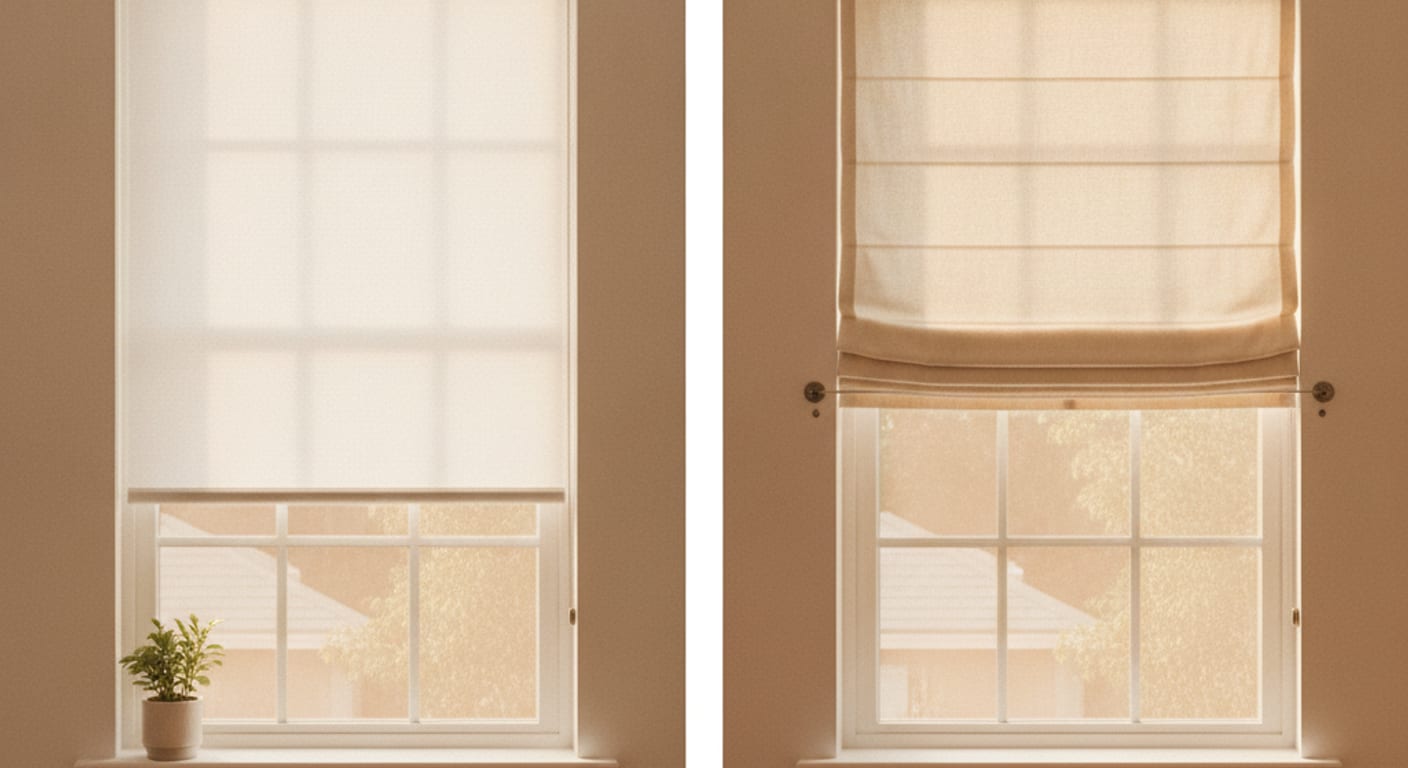
Both roller shades and roman shades are soft window treatments made from fabric, and both come in dozens of colors and patterns, which makes it easy to assume they’re interchangeable. They’re not. The mechanism, the look, and the price point are different enough that the right choice usually comes down to which room you’re furnishing and what you actually need it to do.
How they operate, and why that matters
A roller shade rolls into a tight tube at the top of the window frame when raised, using either a cordless spring-lift or a continuous-loop chain mechanism. The fabric stays flat when lowered, giving a clean, minimal line.
A roman shade folds into soft horizontal pleats as it’s raised, stacking into a fabric bundle at the top of the window rather than rolling into a tube. The pleated structure is what gives roman shades their tailored, textured look, closer to drapery than a flat shade.
That mechanical difference drives most of the practical differences below.
The look: minimal versus tailored
Roller shades read as clean and modern. The flat fabric face and simple roll mechanism fit contemporary rooms, home offices, kids’ rooms, and any space where you want function without a lot of visual weight.
Roman shades read as more formal and designer-oriented. The folded pleats add texture and depth that a flat shade can’t replicate, and roman shades come in a much wider range of fabric patterns and weaves, which makes them a stronger fit for a dining room, a formal living room, or a primary suite where the window treatment is meant to be part of the room’s design statement, not just a functional cover.
Neither is objectively better. A roller shade in a sleek solar-weave fabric can look sharp in a modern kitchen, and a roman shade in a heavy patterned fabric can feel wrong in a casual family room. The look needs to match the room’s overall design intent.
Cost differences
Roller shades are the more budget-friendly option, typically running $150-450 per window installed for standard light-filtering or blackout fabric, with solar-weave fabric running slightly higher for its UV and heat-rejection properties.
Roman shades run higher, typically $250-600 per window, reflecting the more labor-intensive fabrication process and the wider range of premium fabric options available. A flat-fold roman shade in a standard fabric sits toward the lower end of that range, while a hobbled style in a premium fabric with full lining runs toward the top.
For furnishing several rooms in a house at once on a set budget, roller shades often make more financial sense as the default, with roman shades reserved for the one or two rooms where the upgraded look matters most.
Light control and lining options
Both products offer light-filtering, room-darkening, and blackout fabric options, so neither has an inherent advantage on pure light control. The difference shows up in how lining gets added.
Roller shades typically achieve blackout through a dedicated blackout fabric roll itself, keeping the mechanism simple.
Roman shades can add blackout or thermal lining behind a decorative face fabric, which means you get full room-darkening function without giving up the pattern or color you actually want visible from inside the room. This is a meaningful advantage if you’ve found a fabric you love that isn’t inherently opaque enough on its own.
Which rooms favor which product
Bedrooms and nurseries needing real blackout coverage work well with either product, though roller shades in dedicated blackout fabric tend to be the more budget-conscious default, while roman shades with blackout lining suit a primary bedroom where design matters more.
Sunrooms and Florida rooms dealing with heavy glare and heat gain lean toward roller shades in solar-weave fabric, since the flat profile and heat-rejecting weave are purpose-built for that problem.
New-construction homes across Central Pinellas that moved in with nothing but builder-grade blinds are a common roller shade upgrade, since it’s the fastest, cleanest, most affordable path to a finished look across a whole house.
Formal dining rooms, living rooms, and primary suites where you want a tailored, fabric-forward finish are where roman shades earn their higher price point, particularly when layered with plantation shutters or drapery for a more finished, designer room.
Home offices and media rooms where screen glare is a factor work well with either, though roller shades in a light-filtering or solar fabric tend to be the more common practical choice.
Humidity and Florida-specific considerations
Both products hold up fine in Florida’s climate when made with quality fabric, though roman shades in a bathroom or another consistently high-moisture space need a mildew-resistant treatment or performance fabric to hold up well over time, and even then they’re not usually the first recommendation for a shower-adjacent window. Roller shades in a solid, non-porous fabric generally tolerate occasional humidity exposure a bit more forgivingly, though neither is the ideal choice for a genuinely wet environment.
For west-facing rooms and Gulf-facing windows with constant UV exposure, solar-weave roller shade fabric is specifically engineered for heavy sun and tends to hold up better against fading than a standard decorative fabric used in a roman shade.
Cleaning and expected lifespan
Roller shades are the easier of the two to maintain day to day. A flat fabric surface wipes clean with a damp cloth or a light vacuum brush attachment, and there are no pleats or folds to trap dust the way a fabric-heavy treatment can. Most quality roller shades last 8-12 years with normal daily use before the fabric or mechanism needs replacing, with sun exposure being the biggest factor in how fast a specific window’s shade shows wear.
Roman shades take a bit more care given the folded structure, which does collect dust in the pleat lines over time and generally needs a gentler cleaning approach, light vacuuming with a brush attachment rather than a damp wipe, since many roman shade fabrics aren’t built to handle moisture the way a roller shade’s more utilitarian fabric is. Well-maintained roman shades in a climate-controlled room can last just as long as roller shades, but they show wear differently, typically in the pleat crispness and fabric color rather than mechanical failure.
Layering both together
These two products don’t have to be an either-or decision within a single home. Many of the whole-house projects we route across Pinellas County mix roller shades in casual spaces, kitchens, kids’ rooms, home offices, with roman shades reserved for the formal dining room or primary suite where the tailored look is worth the added cost. That approach gets you the budget efficiency of roller shades where function matters most and the design payoff of roman shades where the room calls for it.
Making the final call
If you’re still torn between the two, start with the room’s purpose rather than the fabric catalog. A room built for daily function, a kitchen, a kid’s bedroom, a home office, generally points toward roller shades for the combination of durability, ease of cleaning, and lower cost. A room built to make an impression, a formal dining room, a primary suite, a living room used for entertaining, generally points toward roman shades for the tailored, textured finish that reads as more considered and designed.
Budget constraints across a whole-house project are also worth weighing honestly upfront. It’s often better to do every room in roller shades consistently than to do half the house in roman shades and run out of budget before finishing, leaving a mismatched, half-completed look. Phasing a project, roller shades everywhere now with a plan to upgrade one or two formal rooms to roman shades later, is a reasonable middle path if the full roman shade budget isn’t available yet.
Which is cheaper, roller shades or roman shades?
Roller shades are less expensive, typically $150-450 per window installed versus $250-600 for roman shades. The cost difference reflects a simpler manufacturing process and generally less premium fabric options, though both products offer a wide range of price points depending on fabric and features chosen.
Which looks more formal, roller shades or roman shades?
Roman shades read as more tailored and formal thanks to their folded pleat structure and wider range of designer fabric patterns. Roller shades read as clean and modern, which fits casual and contemporary rooms better than a formal dining room or primary suite.
Can I get blackout coverage with either option?
Yes. Roller shades typically achieve blackout through a dedicated opaque fabric roll, while roman shades can add blackout lining behind a decorative face fabric, letting you keep a pattern you love while still getting full room-darkening function.
Is one better for Florida humidity than the other?
Both hold up reasonably well with quality fabric, though roman shades in a bathroom or high-moisture room need a mildew-resistant treatment to perform reliably long term. Solar-weave roller shade fabric is specifically built for heavy Florida sun exposure and tends to resist fading better in west-facing rooms.
Not sure which one fits your room? Call (727) 000-0000 and we’ll connect you with a local installer who can bring fabric samples and walk you through both options against your actual windows, whether you’re in Dunedin or anywhere else in Pinellas County.