Common questions. Straight answers.
Most of what Pinellas County homeowners ask before they book. Don't see your question? Call us at the number in the header.
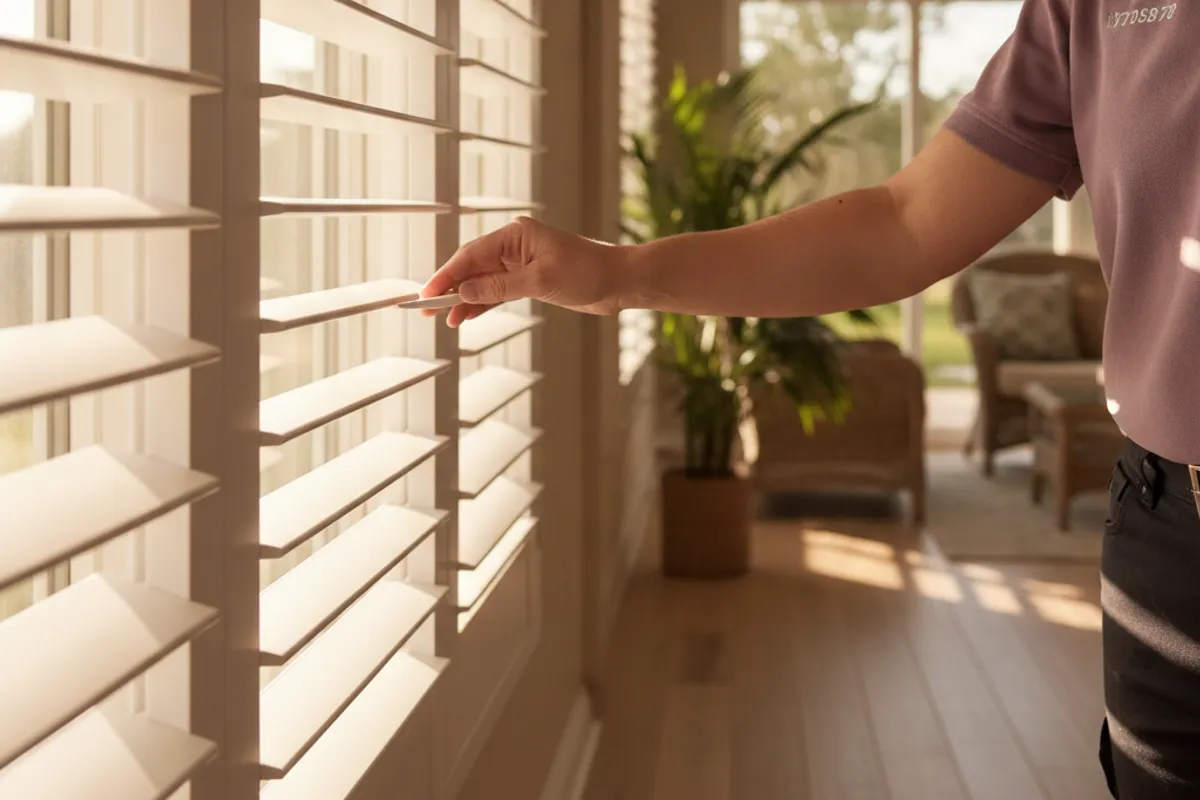
Choosing Treatments
What is the difference between plantation shutters and blinds?
Plantation shutters are solid, hinged wood or composite panels built into the window frame, so they hold their shape for decades and add real resale value to a home. Blinds are lighter, faster to install, and cost less up front, but the slats and cords wear out sooner, especially in a sun-heavy room. In Pinellas homes with full southern or western exposure, shutters usually pay for themselves in durability. For a rental or a room you might redo in a few years, blinds are the more practical call.
Should I get blackout or light-filtering shades for my bedroom?
Most Pinellas bedrooms do better with blackout or near-blackout cellular or roller shades, since the county sits far enough south that summer sunrise comes early and hits hard. Living rooms and kitchens usually work better with light-filtering shades or shutters left partly open, so you get privacy and airflow without losing natural light during the day. If a room faces west toward the Gulf, afternoon glare is the bigger issue and a light-filtering or solar-tinted option often solves it without going fully dark.
What holds up best in a sunroom or lanai with a lot of direct sun?
Faux wood blinds, vinyl or PVC-based shutters, and solar shades handle direct Gulf-coast sun better than real wood or fabric, which can warp, fade, or crack over a few summers of heat and humidity. Cellular shades with a UV-resistant coating are another solid option if you want some insulation value along with the sun protection. During your in-home measure, the pro can tell you which materials are rated for that kind of sun exposure before you commit.
Do I need different treatments for a condo on the Gulf Beaches versus a mainland home?
Often, yes. High-rise condo windows along the Gulf Beaches tend to be taller and see more direct salt-air corrosion on hardware, so stainless or coated components matter more there than on a mainland home a few miles inland. HOA rules in a lot of beach buildings also restrict exterior-visible treatments to specific colors or styles, so it's worth checking your association's guidelines before ordering. The pro doing your measure can flag anything that might run into an HOA restriction.
Measuring & Install
How do I get an accurate measurement before ordering?
You don't measure it yourself. A local pro comes to your home, measures every window by hand, and accounts for things like uneven frames or wall depth that a DIY tape-measure job usually misses. Custom shutters and blinds are built to those exact measurements, so a mismeasure means a treatment that doesn't sit flush or close properly. This is why the in-home measure is free and not optional.
Inside mount or outside mount, which should I choose?
Inside mount sits within the window frame and gives a cleaner, built-in look, but it needs enough frame depth to hold the hardware. Outside mount covers the frame and extends past it, which works well for windows with shallow depth, uneven trim, or when you want the treatment to block more light around the edges. The pro checks your frame depth during the measure and tells you which option actually fits before you pick a style.
How long does a typical installation take?
Installing an already-built order usually takes a few hours for a standard-size home, depending on the number of windows and whether it's blinds and shades or hinged shutters, which take a bit longer to hang and adjust. The bigger time factor is the build itself: custom shutters and blinds are made to your measurements, so the wait between ordering and installation is usually two to four weeks. Stock roller shades and simple blinds can sometimes be installed the same week.
Can existing hardware be reused, or does everything get replaced?
It depends on the condition and type. Mounting brackets and headrails in good shape can sometimes be reused for a like-for-like replacement, which saves a little on labor. But custom shutters almost always need new frames since they're built to fit a specific opening, and corroded or salt-damaged hardware on older Gulf Beaches homes usually needs full replacement anyway. The pro tells you honestly what can stay and what has to go during the measure.
Motorization
How does a motorized shade get power, battery or hardwired?
Most residential motorized shades in Pinellas homes run on rechargeable battery packs built into the headrail, which typically last 6 to 12 months per charge depending on how often you use them. Hardwired options exist for windows you'll never want to think about again, but they need an electrician to run power to the mounting point, which adds cost and usually only makes sense during a larger renovation.
Can motorized shades connect to Alexa or Google Home?
Yes, most motorized shade systems sold today pair with a smart hub that connects to Alexa, Google Home, or Apple HomeKit, so you can control them by voice or app alongside your other smart-home devices. You can also set schedules, like shades that close automatically at sunset or open when you wake up. The pro can tell you which brands in your quote support the smart-home ecosystem you already use.
What happens to motorized shades during a power outage?
Since most residential units run on battery, not house current, a power outage doesn't affect them directly. The shade stays wherever it was last positioned and still responds to the remote or app until the battery runs down. Hardwired systems tied to whole-home power would go dark in an outage unless the home also has backup power, which is worth asking about if you're pairing motorization with a generator install.
Is motorization worth it for hard-to-reach windows?
This is usually where motorization earns its cost fastest. Tall Gulf-facing windows, skylights, and stairwell windows are the ones homeowners actually struggle to reach with a manual wand or cord, and a remote or app removes that problem entirely. For a standard-height living room window you can reach easily, motorization is more of a convenience upgrade than a necessity.
Hurricane Protection
Do hurricane shutters need a building permit in Pinellas County?
It depends on the type and how it attaches to the home. Storm shutters that involve structural anchoring, like accordion or roll-down systems mounted into the wall or frame, often fall under Florida building permit rules depending on scope. Decorative or lightweight panel systems may not. Readers should confirm permit requirements with their local building department, and the installing pro typically handles that step as part of the job.
What is the difference between accordion and roll-down hurricane shutters?
Accordion shutters fold against the wall beside the window when open and pull closed like a bellows, which makes them one of the faster manual options to deploy before a storm. Roll-down shutters store in a housing above the window and lower on a track, either by hand crank or motor, and offer a cleaner look when retracted since nothing sits visible on the wall. Roll-down systems generally cost more but deploy faster, which matters if you're not always home when a storm warning goes out.
Are decorative shutters the same as storm-rated shutters?
No, and this trips up a lot of homeowners. Decorative shutters mounted on either side of a window for curb appeal are not rated to protect against wind-borne debris and don't meet Florida's impact standards. Storm-rated shutters are tested and rated for specific wind speeds and impact resistance. If hurricane protection is the goal, confirm the product's actual wind and impact rating, not just that it's called a shutter.
How much warning time do I need before a storm to get shutters installed?
Ideally, shutters go in well before hurricane season starts in June, not during a storm watch when every installer in the county gets the same calls and supply runs thin. If you're starting from scratch, plan for several weeks between the initial measure, permitting if it's required, and installation. Homeowners who wait until a storm is named in the Gulf are usually looking at temporary plywood instead of a proper installed system.
Pricing & Process
How much do custom window treatments cost?
Pricing varies a lot by material and window size. Faux wood blinds and basic roller shades tend to be the most budget-friendly option per window. Real wood plantation shutters and motorized shades sit at the higher end given the materials and hardware involved. Because every home's windows are different, the honest answer only comes from a free in-home measure, where the pro gives you a real, written price for your exact windows.
Is the in-home measure and quote actually free?
Yes. A local pro visits your home, measures your windows, and gives you a written estimate at no cost and with no obligation to book. You only pay once you approve a quote and place an order.
How soon can installation happen after I approve a quote?
Custom shutters and blinds are built to your measurements, so most orders take two to four weeks to arrive before installation can be scheduled. Stock roller shades and simple blinds move faster, sometimes installed within the same week. The pro gives you a realistic timeline as part of your written quote so there are no surprises.
Do you offer financing or payment plans?
Financing availability depends on the local pro assigned to your job, since Pinellas Shade Pro is a referral service and not the installer itself. Ask about payment options during your in-home measure, and the assigned pro can walk you through whatever they offer.
Ready to talk custom window treatments?
Call for a free in-home measure and quote. Same-week scheduling on most jobs.