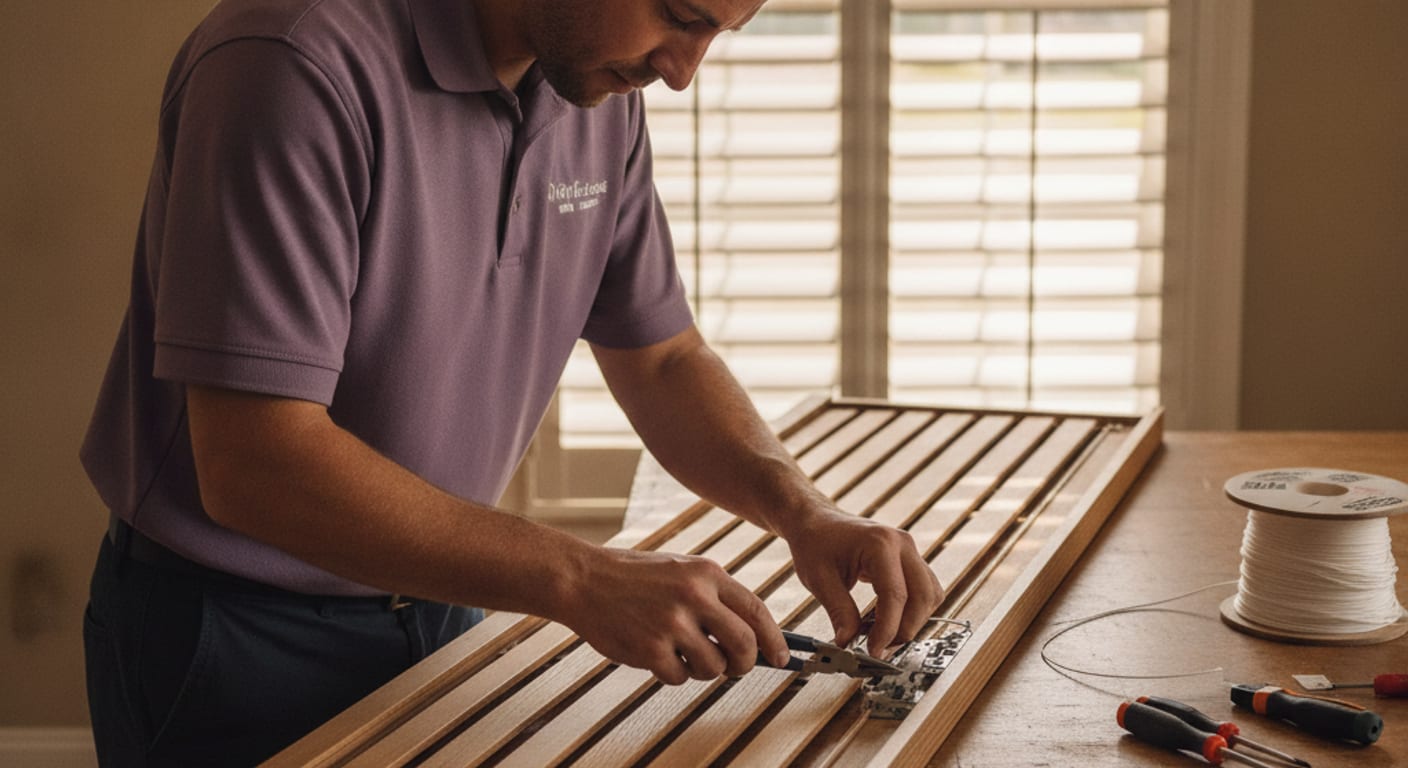
A blind that won’t raise evenly or a lift cord that’s snapped doesn’t automatically mean it’s time to buy new window coverings. Restringing and slat repair usually cost a fraction of full replacement, and for a good-quality blind that’s otherwise in solid shape, repair is almost always the smarter money. The trick is knowing when a repair actually makes sense versus when you’re throwing good money after a blind that’s already past its useful life.
Start with what’s actually broken
Not every blind problem is the same problem, and the fix depends entirely on which part failed.
A frayed, snapped, or tangled lift cord is one of the most common issues, and it’s almost always a repair situation rather than a replace situation, assuming the rest of the blind is in decent shape. Restringing replaces the cord mechanism without touching the slats or the headrail.
A few bent or cracked slats on an otherwise healthy blind is also typically a repair, since individual slats can often be replaced to match the existing set without redoing the whole unit.
A headrail mechanism that’s worn out, sticking, or won’t hold tension anymore is a bit more involved but still often repairable, particularly on higher-quality blinds and plantation shutters where the headrail hardware was built to be serviced rather than disposable.
Widespread sun damage across most of the slats, visible fading, warping, or brittleness throughout the whole unit, points toward replacement, since repairing individual pieces on a blind that’s degrading everywhere doesn’t solve the underlying problem.
The real cost comparison
Cord or slat repair typically runs $60-150 per blind, and full restringing runs $15-30 per linear foot. Compare that to a new custom blind, which usually starts around $10-25 per square foot for faux wood alone before installation labor, and the math tips clearly toward repair for anything that isn’t already falling apart.
For a single blind with a broken cord, repair costs a fraction of replacement in nearly every case. The calculation shifts once you’re looking at a blind with multiple simultaneous problems, since stacking several repair costs together can start to approach what a new blind would run, at which point replacement starts making more financial sense even before factoring in the age of the existing unit.
Age and condition matter more than the specific problem
A general rule worth applying: if a blind is more than 10-15 years old and already showing broader signs of age beyond the specific issue you’re calling about, replacement usually delivers better long-term value even if a repair is technically possible. An old headrail mechanism that’s been repaired once already, combined with slats that are starting to show their age even if they’re not yet cracked, is a signal the whole unit is approaching the end of its useful life regardless of which specific part just failed.
Conversely, a five-year-old blind with a snapped cord and otherwise pristine slats is a clear repair case. The frame, mounting hardware, and slats still have years of useful life left, and there’s no reason to replace a functioning product over a single failed mechanism.
Where repair almost always wins
Plantation shutters with a single failed hinge or a tension issue are strong repair candidates, since the panels themselves, the most expensive part of the product, are usually unaffected by a hardware failure and can keep performing well for years once the mechanical issue is addressed.
Quality real wood or faux wood blinds with a broken lift cord but intact slats are close to the textbook repair case, fast, affordable, and gets the exact same blind working like new.
Corded blinds you want converted to cordless for child safety reasons are worth handling as a repair-and-upgrade combination rather than a full replacement in most cases, since converting the lift mechanism during a repair visit is often more cost-effective than buying an entirely new blind just to get cordless operation.
Where replacement is the better call
Blinds with multiple failing parts at once, a broken cord and cracked slats and a sticking headrail, are usually past the point where individual repairs make financial sense compared to a fresh install.
Blinds showing visible sun damage across most of the slats, common on west-facing windows and Gulf-facing rooms after years of direct Florida sun, tend to have a fabric or finish problem that repair can’t fix, since you can’t restore faded or brittle material.
Blinds that are more than a decade old and already showing general wear beyond the immediate issue are usually better replaced, since sinking repair money into an aging unit often just delays an inevitable replacement while adding cost along the way.
Blinds you inherited from a previous owner with an unknown history and mismatched or discontinued styling are sometimes better replaced outright, particularly if matching exact slat color or fabric on an older, discontinued product isn’t possible.
Getting a straight answer instead of an automatic upsell
The installers we connect you with diagnose the actual problem first and give you both numbers, repair cost and replacement cost, so you can decide based on real information rather than a default recommendation toward the more expensive option. A blind repair visit that turns into an honest “this one’s not worth fixing” conversation is a normal, expected outcome, not a failed sales call.
If replacement ends up being the right call, that same visit is a good opportunity to talk through whether custom blinds in a different material or a cordless upgrade makes sense for the room, rather than simply replacing like for like without reconsidering what’s actually the best fit.
Why DIY repair usually costs more in the long run
It’s tempting to order a replacement cord kit online and fix a blind yourself, and for a simple, accessible mechanism that can work out fine. But restringing a headrail correctly, especially on plantation shutters or higher-end blinds with a tensioned lift system, requires matching the exact cord gauge and routing the mechanism through the headrail in the right sequence. Getting it wrong doesn’t just fail to fix the problem, it can strip or damage the headrail hardware, turning a simple repair into a full headrail replacement that costs more than a professional repair visit would have in the first place.
For a genuinely simple fix, like replacing an obviously snapped exterior cord on a basic vertical blind, DIY can make sense if you’re comfortable with basic tools. For anything involving the internal lift mechanism, tilt wand assembly, or a headrail that’s already showing signs of wear, a professional repair visit protects the investment you already made in the blind rather than risking a small problem turning into a much larger one.
What to expect during a repair visit
Most cord replacements and slat repairs are completed in the same visit, often within an hour or two depending on the number of blinds involved and the extent of the damage. Full restringing across multiple windows may take longer if headrail hardware also needs attention. Repairs on blinds you didn’t originally purchase from the installer are handled the same way, including big-box store blinds and previous owners’ installs, with the main limitation being exact color or fabric matching on discontinued products.
How much does blind repair cost compared to replacing?
Cord or slat repair typically runs $60-150 per blind, and full restringing runs $15-30 per linear foot. A new custom blind usually starts around $10-25 per square foot for faux wood alone before installation. For a blind in otherwise good shape, repair is almost always the cheaper option.
How do I know if my blind is worth repairing?
If the frame, slats, and hardware are still in solid shape and it’s just a cord or mechanism that’s failed, repair almost always makes sense. If the blind has multiple failing parts, visible sun damage across most of the slats, or is more than 10-15 years old and already showing broader wear, replacement usually delivers better long-term value.
Can you convert my corded blinds to cordless during a repair?
Yes, this is a common request, especially in homes with young kids or grandkids visiting regularly. Converting a corded lift to a cordless or motorized system during a repair visit is often more cost-effective than buying a whole new blind just for the cordless upgrade.
Do you repair blinds I didn’t buy from you?
Yes. Repairs are handled regardless of who originally installed the blinds, including big-box store purchases and previous owners’ installs. The main limitation is matching exact slat color or fabric on an older, discontinued product, which gets flagged upfront if it’s a concern for your specific blinds.
If you’ve got a blind that’s stopped working right, call (727) 000-0000 and we’ll connect you with a local pro who can give you a straight answer on repair versus replacement, whether you’re in Safety Harbor or anywhere else in Pinellas County.