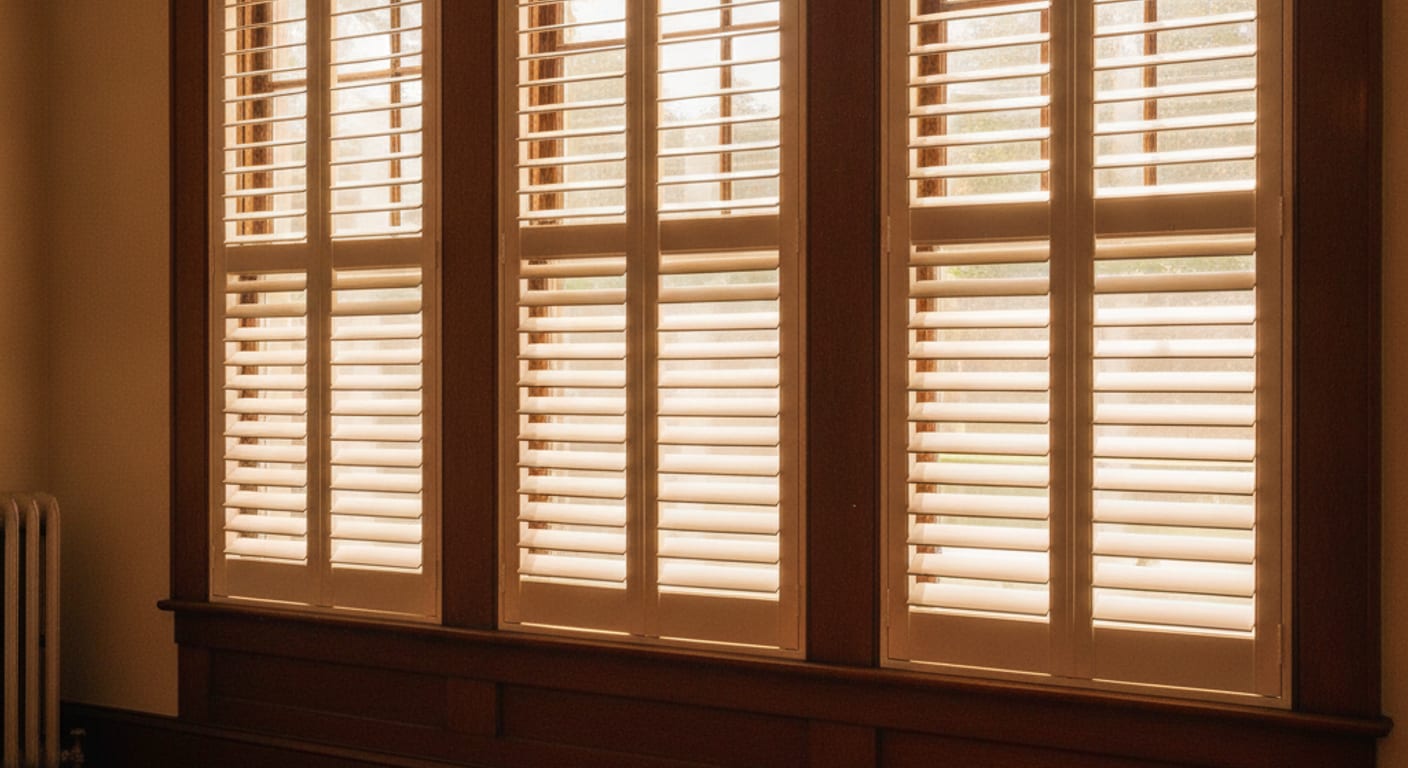
Getting a quote for plantation shutters can feel like a guessing game until someone actually measures your windows. Prices swing based on material, window count, and how your home is built, and a homeowner in a 1920s Old Northeast bungalow is going to pay a different number than someone in a new-construction home in Palm Harbor. Here’s what actually drives the cost, with real ranges pulled from the two materials that make sense for Pinellas County’s climate.
The two materials that matter here
Most quotes in this market come down to a choice between polymer (poly) shutters and basswood shutters, and the decision has more to do with humidity than budget.
Poly shutters are a solid vinyl-composite panel that resists moisture completely. They won’t warp, swell, or crack in a bathroom, kitchen, laundry room, or a home that sits closed up for weeks at a time, which matters for the seasonal and vacation properties scattered across the Gulf beaches. Poly typically runs $20-30 per square foot installed.
Basswood shutters are real hardwood, lighter than poly for large openings and generally considered the more premium look. They perform well in consistently air-conditioned living rooms and bedrooms, but they’re not the right call for a bathroom or a beach cottage that goes unoccupied through the off-season. Basswood typically runs $30-45 per square foot installed.
A lot of homeowners end up mixing the two: basswood in the formal living areas, poly in the bathrooms and laundry room. That split shows up constantly in the plantation shutters work we route across the county.
What actually drives the final number
Square footage per window is the biggest single factor, followed by window count. A standard 3-foot by 5-foot window runs about 15 square feet, so at $20-45 per square foot, a single window lands somewhere between $300 and $675 depending on material.
From there, a few things push the number up or down:
Frame depth and mount type. Deep window casings in older St. Petersburg homes sometimes need custom framing to mount shutters flush, which adds labor. Newer homes with standard depth openings install faster and cheaper.
Louver size. Larger louvers (3.5-inch or wider) give a cleaner, more contemporary look and generally cost a bit more than standard 2.5-inch louvers, though the difference per window is usually modest.
Divider rails. A shutter panel taller than about 42 inches typically needs a divider rail to keep the louvers from sagging, and split-tier shutters (top and bottom operate independently) cost more than a single full-height panel.
Finish. Stained or custom-painted finishes to match existing trim cost more than a standard white or off-white factory finish.
Real numbers by neighborhood
In Old Northeast, Kenwood, and Roser Park, where original wood-sash windows run tall and non-standard, a typical living room with two or three windows lands in the $1,500-3,500 range, mostly basswood given the consistent AC and the period-correct look homeowners want against original trim.
On the Gulf beaches, in places like St. Pete Beach and Indian Rocks Beach, a whole-home shutter project on an older cottage generally runs $4,000-9,000 depending on window count and wood grade, and poly tends to win out in bathrooms and any room near an exterior door where salt-tinged humidity is a constant factor.
In newer inland construction around Palm Harbor and parts of Largo, standard window sizes and consistent framing keep installs simpler, and a full-house project (ten to fifteen windows) often comes in tighter than the same scope in an older home, since there’s less custom framing labor involved.
Why a phone estimate is never accurate
No reputable installer will give you a firm number over the phone, and that’s not a stall tactic. Window openings in Pinellas County homes vary enough, especially in anything built before 1970, that an in-person measure is the only way to get real numbers. A quote based on a rough size you describe over the phone can be off by hundreds of dollars once someone actually gets a tape measure on the opening.
The installers we connect you with measure every window in person before quoting anything, which also gives you a chance to talk through material and louver choices with the actual opening in front of you rather than guessing from a sample chip.
Whole-home versus room-by-room
Doing every window in one project, rather than a room at a time over a year or two, usually saves money per window. Manufacturing and install crews price more efficiently for a bigger single order, and you avoid the risk of a discontinued finish or louver profile leaving you with a mismatched house down the line.
That said, a phased approach makes sense on a tighter budget. Prioritizing the rooms that get the worst afternoon sun first, typically anything facing west or south, gets you the biggest comfort and fade-protection benefit for the dollars spent, with the rest of the house following in a second phase.
What shutters replace and why it matters for value
A lot of the homes we see still have whatever mini blinds the previous owner left behind, usually warped, yellowed, or hanging crooked after a decade of Gulf humidity. Shutters solve that permanently in a way custom blinds rarely do, since they’re built from materials engineered for Florida moisture rather than adapted for it.
Shutters also tend to add more resale value than blinds when a home goes on the market, which matters if you’re weighing the upfront cost against how long you plan to own the property. For a long-term primary residence, that math almost always favors shutters. For a short-term vacation rental where guests handle window coverings roughly, some owners choose a more affordable option and save shutters for their own home.
Financing and timing the project
Most local installers offer some form of financing for larger whole-home projects, since a $6,000-9,000 job is a real expense to absorb in one payment. Ask about financing terms during your in-home estimate rather than after you’ve already committed to a material choice, since some financing programs have minimum project sizes.
Timing matters too. Custom shutters take 4-8 weeks to manufacture after measuring, so if you’re working toward a specific date, a home sale, a season change, or getting ready for snowbird arrivals, start the process well ahead of that deadline.
Hidden costs that a base quote sometimes misses
A few line items catch homeowners off guard if they’re not asked about upfront. Old blind or curtain removal and disposal is usually included but worth confirming, since some installers treat it as a separate charge on a large whole-home job.
Trim repair is another one. Older St. Petersburg and Gulfport homes with original wood casing sometimes need minor trim repair or filling around a window opening before shutter frames can mount flush, especially if a previous mini-blind installation left screw holes or damage. This is typically a small add-on rather than a major cost, but it’s worth asking your installer to flag it during the measure rather than discovering it on install day.
Custom stain matching to existing trim, rather than a standard factory finish, adds cost and time to the manufacturing process. If matching an unusual or aged wood tone matters to you, bring a trim sample to your consultation so the installer can quote the custom match accurately from the start.
What a typical Palm Harbor or Dunedin project looks like
Inland North Pinellas communities like Palm Harbor and Dunedin see a mix of retiree-heavy established neighborhoods and newer construction, and shutter projects here tend to run a bit more predictably than the older bungalow cores further south. Standard window openings and consistent framing keep labor simpler, and a full-house project of ten to fourteen windows in poly or basswood commonly lands in the $3,500-7,500 range depending on the material split chosen. Homeowners here also ask more often about ease-of-operation features, larger tension knobs and wider louver control rods, given the area’s older resident population.
How much do plantation shutters cost in Pinellas County?
Most installs run $20-45 per square foot depending on material, with poly at the lower end and basswood at the higher end. A typical living room with two or three windows often lands in the $1,500-3,500 range, and a whole-home project runs $4,000-9,000 depending on window count and wood grade.
Is poly or basswood better for a Gulf Beaches home?
Poly is the stronger call for anything near the water or in a bathroom, kitchen, or seasonal property, since it resists moisture completely regardless of humidity swings. Basswood works well in consistently air-conditioned living areas but isn’t the right fit for a beach cottage that sits closed up for months at a time.
Can I get an accurate quote without an in-home measure?
Not a reliable one. Window openings vary enough across Pinellas County’s housing stock that a phone estimate based on a rough size is often off by hundreds of dollars once a professional actually measures the opening. Every quote we connect you with is based on an in-person measure.
Does mixing materials in one house make sense?
Yes, and it’s common. A lot of homeowners choose basswood for formal living areas and poly for bathrooms, laundry rooms, or any space near an exterior door. It’s a practical way to balance look and moisture resistance without overspending on rooms where it doesn’t matter as much.
If you’re ready to get a real number for your home, whether you’re in a bungalow in St. Petersburg or a cottage out toward the Gulf, call (727) 000-0000 and we’ll connect you with a local installer who can get out for a free measure.