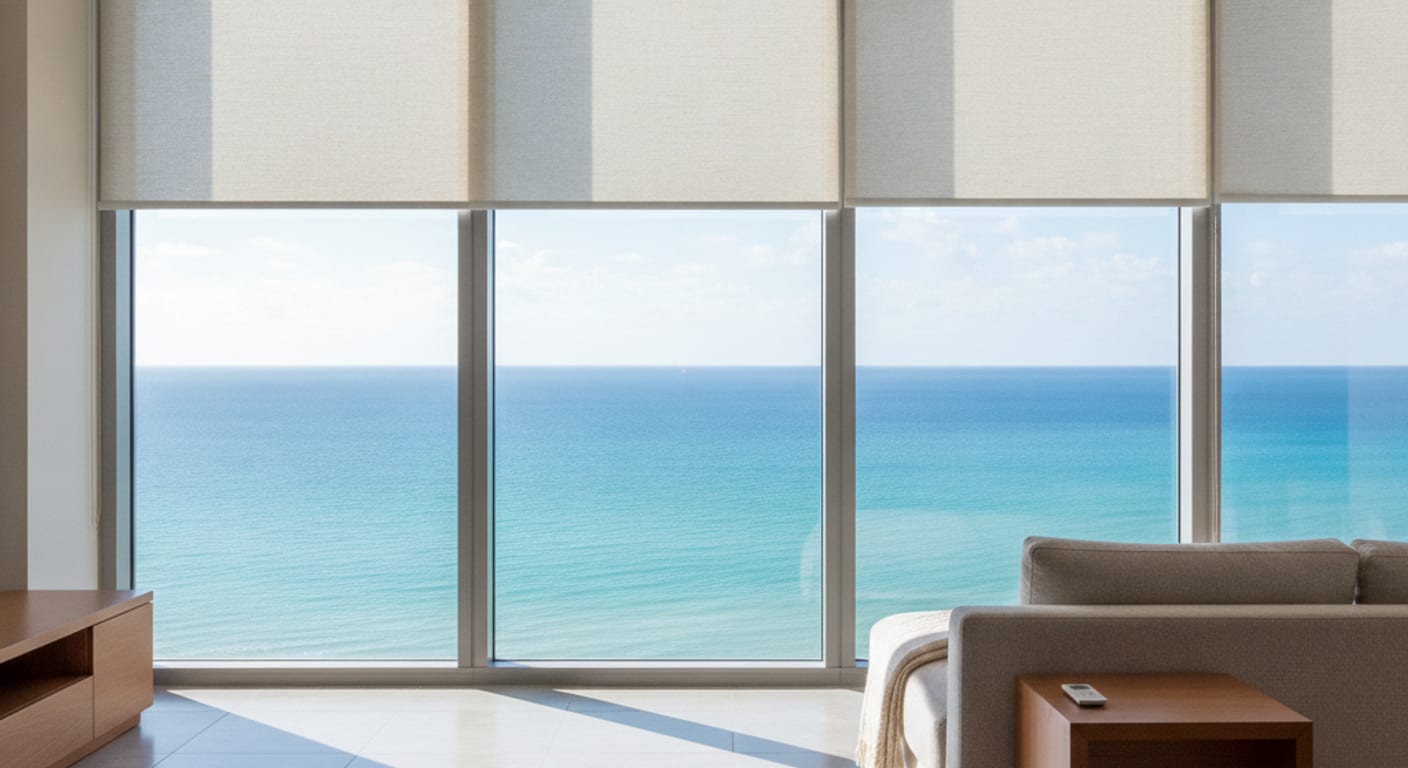
Anyone who’s tried to hand-crank a shade across a floor-to-ceiling window in a high-rise condo knows the problem before it’s ever explained to them. The glass runs eight or ten feet tall, the manual wand is somewhere near the bottom corner, and reaching the top few feet of a wide expanse without a ladder just isn’t realistic. Motorized shades exist for exactly this problem, and they’ve become close to standard in the condo towers along St. Pete Beach, Treasure Island, and Indian Rocks Beach.
The problem with manual operation on tall glass
Standard cord and wand systems were designed for residential windows in the 3-to-5-foot range. Gulf Beaches condo units routinely run floor-to-ceiling glass, sometimes wrapped around a full corner unit, and a manual system on an opening that size is awkward at best and unusable at worst.
Beyond the reach problem, manual shades on oversized glass tend to bind, sag unevenly, or wear out mechanisms faster because they’re being asked to do more than they were built for. A motorized system, sized correctly for the opening, distributes the load evenly and doesn’t rely on a person cranking a wand at an awkward angle.
How motorization actually works
Motorized shades run on one of three power setups, and which one makes sense depends on the unit and how much rewiring you’re willing to take on.
Battery-powered systems use a rechargeable battery pack built into the shade’s headrail. No new wiring required, which makes them the fastest and least invasive option for a condo, especially one where running new electrical isn’t practical or allowed by the building. Battery packs typically need recharging every 6-12 months depending on how often the shade cycles.
Rechargeable systems work similarly but may include a small solar panel option for windows with strong sun exposure, extending time between manual charges.
Hardwired systems connect to house power through a new low-voltage line run to each window. These need an electrician, but they eliminate battery maintenance entirely and are more common in owner-occupied units doing a fuller renovation.
Whichever power source you choose, the shade pairs with a remote, an app, or a voice assistant like Alexa or Google Home through a hub device. Group and scene settings let a whole room, or even a whole unit, raise or lower together on one command instead of window by window.
What this solves beyond just reach
Motorization isn’t only about the tall-glass reach problem, though that’s the most obvious one. A few other things come up constantly in the motorized shades work we route in condo buildings:
Scheduled operation. Shades can lower automatically at sunset or on a heat sensor, which matters in west-facing units taking direct Gulf sun through the afternoon without anyone home to manually close things down.
Aging in place. A resident who finds a pull cord or wand difficult to manage due to grip strength or mobility gets full control back through a remote or a simple app tap.
Vacation rental management. Owners can control shades remotely between guest stays, both to manage interior temperature and give the unit a lived-in look when it’s sitting empty.
Power outage resilience. Battery and rechargeable systems keep working through an outage since they don’t rely on house power at all, which matters in a region where storm-related outages are a real seasonal reality rather than a rare event.
HOA coordination in condo buildings
Most Gulf Beaches towers have HOA or building rules about what’s visible from outside the unit, sometimes requiring a specific backing color or fabric type on anything facing the street or the water. This applies to motorized shades the same way it applies to any other treatment.
Installers who work regularly in condo buildings check a building’s HOA rules before ordering anything, which avoids the frustrating scenario of installing a shade that then has to be reordered because the backing color doesn’t meet building standards. If you’re in a building you haven’t worked with an installer in before, ask about this step directly during your consultation.
What it costs
Motorized single-window installs typically run $600-1,800 depending on the base shade type, whether the motor is battery-powered or hardwired, and the control system you choose. A whole-unit project with scene programming across multiple rooms runs higher, particularly for a corner unit with wraparound glass.
Battery and rechargeable systems generally come in on the lower end of that range since there’s no electrical work involved. Hardwired installs cost more upfront due to the electrician coordination but eliminate ongoing battery maintenance for the life of the system.
Pairing motorized shades with the right base product
Motorization is a mechanism, not a product on its own. It gets paired with cellular, roller, or roman shades underneath. In a lot of Gulf-facing units, a cellular shade with motorized lift is the common pairing, since the insulating honeycomb structure helps offset the heat gain from that much west- or south-facing glass while the motor handles the reach problem.
Roller shades in a solar-weave fabric are another common combination for units where cutting glare without fully losing the water view matters more than insulation value.
Choosing a control platform
Lutron and Somfy are the two names that come up most often in the motorized shade work we route across Pinellas condo buildings, and both are established, reliable platforms with strong track records. The practical difference for most homeowners comes down to what other smart-home devices are already in the unit. If a household already runs Lutron lighting controls, staying on the same platform for shades usually means simpler integration and one app instead of two. The same logic applies in reverse for an existing Somfy setup.
For a unit with no existing smart-home ecosystem, either platform works well, and the decision often comes down to which local dealer network and app experience the installer recommends based on hands-on experience with both. Ask your installer directly which platform they install most often and why, since familiarity with a specific system’s quirks matters as much as the brand name itself.
Building approval and wiring logistics
Hardwired motorized systems in a condo building typically require coordination with building management before any electrical work begins, separate from the HOA rules governing what’s visible from outside. Running new low-voltage wiring inside a shared-wall unit sometimes needs sign-off on where cable can run and how walls get accessed, particularly in older towers where the electrical infrastructure wasn’t designed with future smart-home additions in mind.
This is one more reason battery-powered and rechargeable systems have become the more common choice in condo settings specifically. They sidestep the building-approval and wiring-access conversation entirely, which shortens the timeline from decision to install considerably compared to a hardwired project that needs both HOA and building-management coordination before an electrician can even schedule a visit.
What to expect during install
Custom motorized shades take about 2-4 weeks for fabrication after the initial measure, and the physical install itself usually takes a few hours per room. For hardwired systems, the electrician coordination typically happens as part of the same scheduled project rather than a separate visit, so it’s one appointment window rather than two.
How much does motorized shade installation cost in a Pinellas condo?
Most single-window motorized installs run $600-1,800 depending on shade type, motor system, and controls. Battery-powered systems tend to land on the lower end since no new wiring is involved, while hardwired whole-unit projects with scene programming run higher.
Do I need an electrician for motorized shades?
Only for a hardwired system. Battery-powered and rechargeable motors need no new wiring at all and install in about the same time as a manual shade, which makes them the more practical choice for most condo units.
What happens to motorized shades during a power outage?
Battery-powered and rechargeable systems keep working through an outage since they run independently of house power. Hardwired systems typically include a manual override crank or a battery backup option, so a shade is never stuck open or closed.
Can my HOA restrict what motorized shades I install?
Many Gulf Beaches condo buildings do regulate backing color or fabric visible from outside the unit. Check with your building or association before ordering, or work with an installer who routinely handles condo projects and checks this step for you upfront.
If you’re dealing with tall glass and a shade you can’t reach in Indian Rocks Beach or anywhere else along the Gulf Beaches, call (727) 000-0000 and we’ll connect you with a local installer who handles condo motorization regularly.